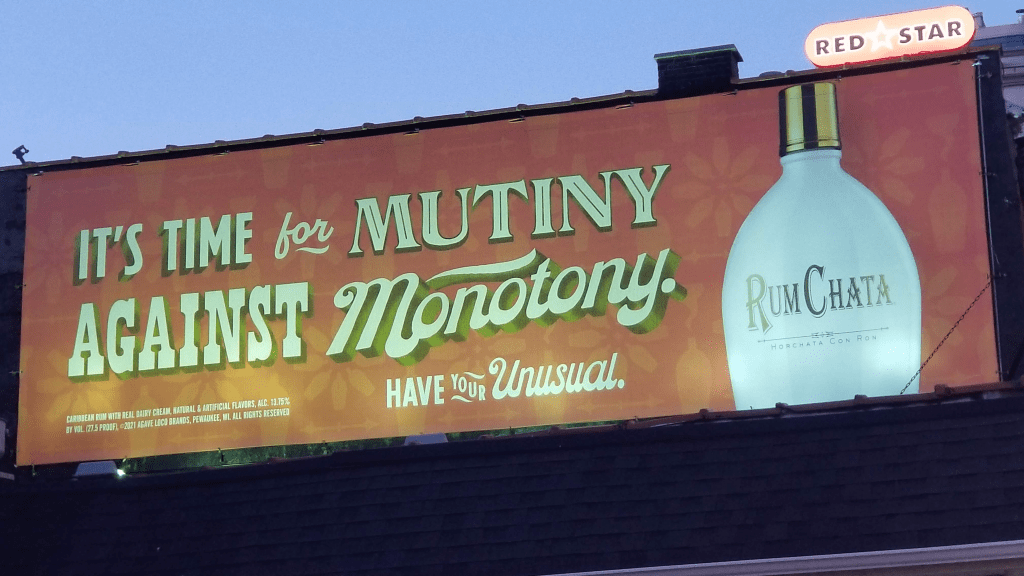
The time has come for my personal mutiny against the tedious sameness found in most professional organizations. While I appreciate the overall sentiment of this billboard, alcohol will not be my brother in arms. The first step in my personal mutiny is to acknowledge the pervasive presence of monotony. The second step is to acknowledge that personal agency is greater than the authority of monotony. These acknowledgements led to uncomfortable questions about purpose and effectiveness of organizations and individuals. What is the purpose of this business? What is my purpose in this business? Did a corporate overlord define this role to be repetitively terrible, resulting in a “time to make the donuts” habit? Or is this just an unhappy accident? Would a corporate overlord trade places with me? Why do I stay?
I notice how exhausted Fred the Baker appears when returning home at the end of the workday. Is he exhausted from a job well done, personally fulfilled by his craft and from feeding people? Or is he exhausted from drudgery? Replace he with me.
Fred the Baker is a metaphor for the average corporate employee, and the donuts are a metaphor for the outputs of many modern workplaces. Commodity ingredients are mixed together, excessively sweetened, and expire by the end of the week. This sounds similar to teams staffed with whomever is available at the lowest price, excessively sweetened by the positivity demanded by disconnected executives, and managed against a waterfall project plan that will expire in a few days. When consumed, the donuts provide a burst of energy followed by a slump, much like the kickoff meeting of a project. If a client would like a different flavor of donut, please consider the flavor of the week which might be agile, wagile, lean agile, agile scrum, water-scrum-fall, scrum of scrums, or any of a multitude of flavors excessively sweetened by aspirations to achieve buzzwords. While these are software development examples, the flavor profile is similar for other business domains.
This dire state of handwaving does not describe all workplaces. Some organizations put great effort into pursuing purpose, and a fraction of those actually deliver purposefully. Audacious visions, clear strategies, compelling leadership, and practiced craftsmanship combine into something special that cannot be communicated with a Venn diagram that represents the people pursuing the purpose. Leading organizations and individual leaders of high performance organizations – or those aspiring to lead – are not focusing on recruiting commodity talent at commodity compensation to produce commodity products or services and managing performance to the mean. Leading companies attract and retain rare talent using top-of-market compensation and provide many opportunities to work collaboratively on a visionary purpose, typically very difficult problems in technology, healthcare, education, public safety, national safety, and the environment. The very difficult problems seem to be where the most money is made, and that attracts the capitalists and the greedy, sometimes one and the same. I am not of the position that making the most money justifies the purpose. A big brand generating billions in annual revenue does not always correlate with big purpose, as seen by the correlation of social media growth to female teen suicide. How the money is acquired and who shares in the rewards is what matters.
We have seen in the COVID era that global behemoths with purpose can literally save save lives. Pfizer surely has some internal problems that come with being 170+ years old and generating $40B+ in annual revenue. Unwholesome behaviors develop inside of the pursuit of large numbers. However, the company did rally to create and sustainably produce a life saving vaccine that I was privileged to receive three times as of December 2021. Pfizer’s mission statement is “Innovate to bring therapies to patients that significantly improve their lives.” is not surprising to hear. The lives of people all around me have been significantly improved and I personally did not pay a cent to Pfizer along the way. Pfizer delivered a purpose-backed outcome greater than profit. Can automobile companies pivot to the purpose of sustainability? Can food and beverage companies pivot to products that don’t shorten the life of consumers?
Startups that we have not heard of focus almost exclusively talent and workplace conditions to pursue the founder’s visions, with a few later bursting into relevance, almost all with dreams to change the world. I am not discounting that many startups have terrible bro cultures or look to exploit regulatory gaps and the desperation of people without employment security. Those startup endeavors have a different poison than the monotony of the donut factory. Future posts will explore some of the purpose filled startups and scaling businesses that I have been honored to be involved with and a few that were toxic. I am keenly interested in the Main Street examples, too. Even the old school industrial distribution business that want to remain relevant against Amazon are doing this – paying 150% of commodity wages with healthy profit sharing plans to recruit 2x the output and empowering employees to provide unique services experiences to customers. These examples will also be shared.
Of course, the 90% gross margins in successful software and data businesses allow for high compensation and investments that might not return results. The majority of businesses can’t allocate millions of billions to pursuing transformative purpose through multiyear talent strategies. But small businesses with 30% gross margins can create cultures of engagement at nearly zero cost by listening to employees, acting on small suggestions, and treating each employee as unique and valuable. Most businesses have a great whitespace with nearly limitless opportunity to innovate for employees, clients, customers, and suppliers. My next several months of traveling around the United States and perhaps my next professional role will explore this whitespace.
As I undertake the upcoming career break, I will reflect on the metaphor of Fred the Baker. I won’t have many actual donuts, unless offered at the distributor branch locations that I plan to visit. Donuts used to be available at distribution centers in the early morning. The giveaway was intended to influence loyalty and provide a momentary distraction for the plumber or electrician as the desk clerk quoted prices and lead times, typically for a commodity product. The desk clerk was anything but commodity labor, knowing the name of every contractor and knowing when to extend an extra week of credit because the contractor needs a little extra cash flow until the nuisance lien his deadbeat customer filed is thrown out of court. The desk clerk extended some grace to the local handyman by not making him pay cash on the same day he must make a child support payment for a daughter that he doesn’t get to see very often because of a custody battle. The quiet handshake lasted a second longer and the grip was tighter than usual. The clerk understood the purpose of the business was something more than net daily sales, and the clerk possessed more valuable customer intelligence about credit worthiness than any ERP or CRM or customer database or algorithmic personalization engine. In my experience, the strategy worked. Take away the donuts and people complained! It is an easy jump from taking away the donuts to the customer wondering when credit would be cut off. I am unsure if offering free donuts remains in practice in the COVID-19 era, but if I find some, there will be pictures and a post.
Mutiny against the monotony. Today. Every day.
 DISCOVER THIS WORLD