
Date photographed: 08-Feb
The initial drafts of this post contained incomplete thoughts regarding agency life and brand definition. Thankfully, revisions are allowed and encouraged. More simply:
In an oversized tribute to an enduring consumer brand, a 60 foot tall Green Giant statue casts a long shadow on a kitschy roadside museum in Blue Earth, Minnesota. Inside the single story building, a collection of exceedingly well preserved Green Giant brand memorabilia spanning over 100 years is accessible without an admission fee. The ephemera of 20th century American economic expansion is on full display as both celebration and memorial, and many items can be handled. Toys, glassware, political buttons, signs, and myriad promotional materials are curated and presented without long form descriptions. The location and statue also commemorate the completion of nearby Interstate 90, another artifact and enabler of commerce.
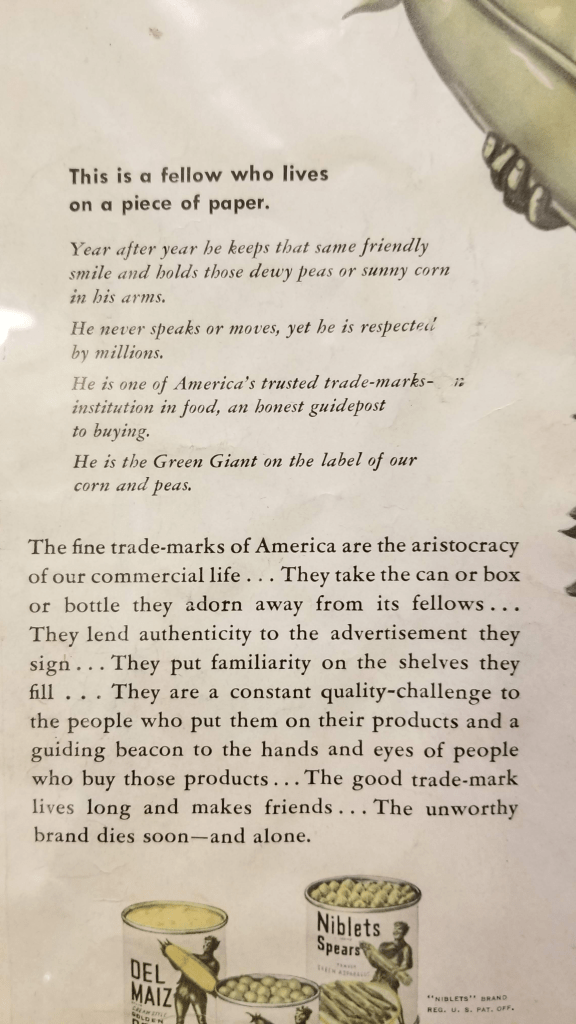
Among the museum artifacts is a framed excerpt from a print advertisement – or a page from an internal brand book – that explains the essence of the Green Giant brand. The narrative was distinct and powerful, voiced in my head by Don Draper, inclusive of Don’s charm and challenges. A narrative that would enthrall a chief marketing officer and put an end to agency account team debates. Pure 1950s brand advertising:
Date photographed: 08-Feb-22
Friendly. Respected. Trusted. Institution. Honest guidepost. Authenticity. Familiarity. Constant. Quality. Guiding beacon.
Leo Burnett can fight Don Draper, and the winner can take a bow and claim the manifesto is complete and timeless, defended with a fisticuff.
A portion of the themes are external and some are internal, although I am unsure if the blend was intentional. Simple words when applied to a human life might generally describe potential aspirations or values generally considered positive and attractive. What high standards – almost unobtainable and aristocratic! The themes definitely attracted me and scared me throughout my own life.
Also of note are the descriptive attributes shunned in the current discussion of modern brands, and frankly not needed to enhance a giant that could stand alone. Institution. Aristocracy. Hands and Eyes. Dies alone. In the context of the 1950s, expressions of authority, dominance, and victory were commonplace and valued. Aristocracy in this presentation means refinement and genteel – separation and elevated distinction from the masses – but not traditional royalty or monarchy. Outright declaration of a ruling class and worker class would have been a bad look less than 10 years after a war fought against authoritarian rule. We seem to be more comfortable with class separation now, seemingly not recognizing how we celebrate money collectors as royalty while avoiding anything with a label of aristocratic. But again, the values of the 1950s recognized “the finer things in life” only a few years after not having many things during wartime or not having any assurance of life. The Green Giant was a constant friend in the era of backyard bomb shelters.
A challenge for enduring consumer brands is expressing consistency while managing inevitable change. Consistent quality, consistent availability, and consistent value define a brand while marketplace conditions and consumer sentiment changes rapidly. The brand strategists for Green Giant created a framework that managed change, and in many ways endured for well over 50 years. A challenge for humans is expressing consistency while managing inevitable change. Humans can create frameworks with values, morals, and ethics. Having a steady framework that can be applied over decades can be valuable, as is modifying the framework based on evolving standards.
The framed advertisement is a relic of the past, quaint to some, offensive to others. The museum contained many other examples of memorable advertising across economic eras. Green Giant does not use this language in 20th century advertising, nor does Green Giant use humorous political buttons to advertise or associate the brand with ashtrays. Standards and practices change. This pattern of change is ever present, everywhere.
Taken as a lesson that can be applied to my life, Don was insistent that the efforts to apply brand standards and to evolve can produce positive outcomes:
The good trademark lives long and makes many friends.
 DISCOVER THIS WORLD